
Leisure Centre CHP: The Maths Still Works. The Timing Doesn't.
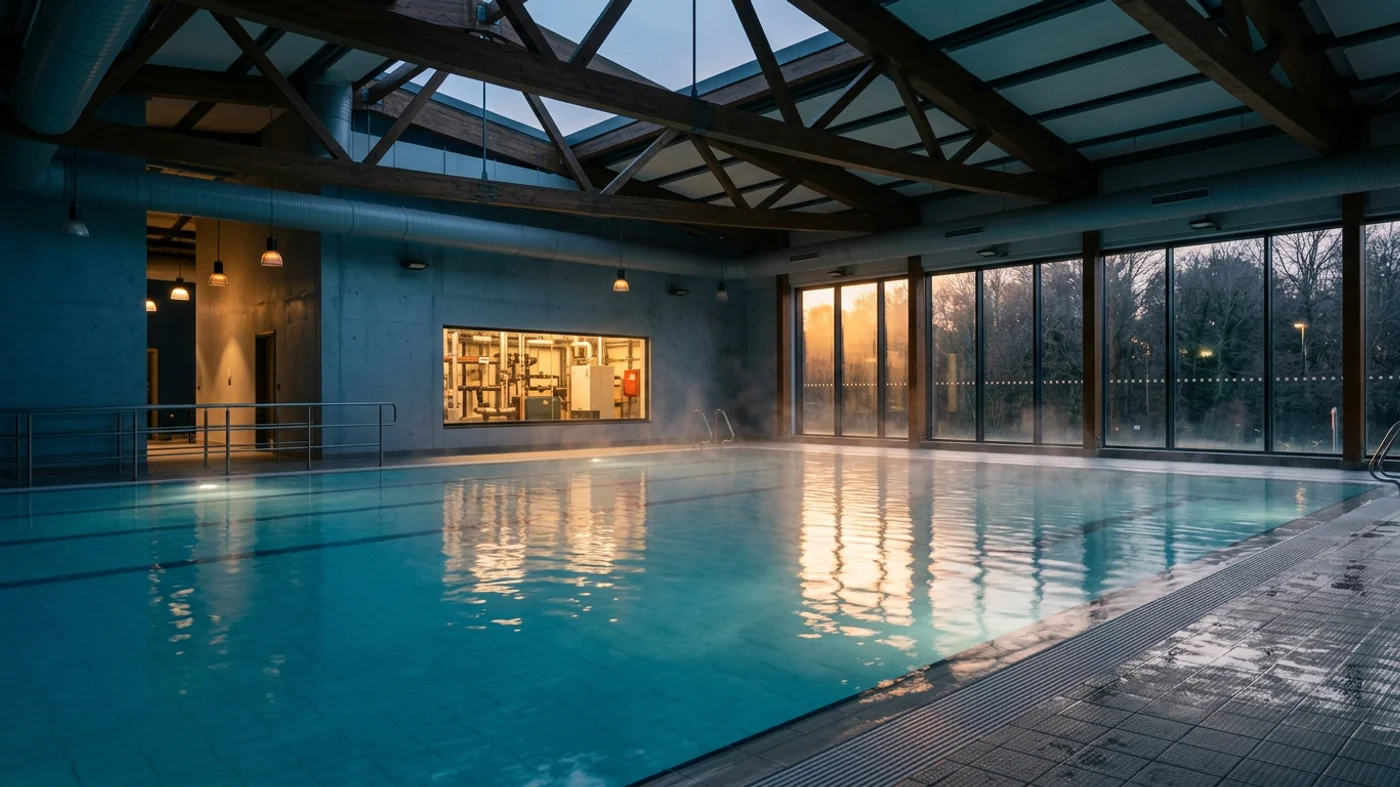
The gas engine everyone’s telling your leisure centre to buy might be the right decision for entirely the wrong reason.
I’ve looked at CHP feasibility studies for public leisure facilities for the better part of two decades, and the sales pitch hasn’t moved since around 2008: a constant base heat load, cheap self-generated power, a fast payback. What has moved is everything sitting underneath that pitch — the price of gas relative to electricity, the shape of the Public Sector Decarbonisation Scheme, and the fact that the emergency funding that kept pools open through the energy crisis has now largely ended.
The economics of leisure centre CHP still stack up. The politics and the timing increasingly don’t — and almost nobody selling the kit is telling you that.
The economics that make leisure centre CHP look obvious
Start with the load. A community leisure centre with a 25-metre pool typically spends £150,000 or more on energy every year, and water heating alone accounts for 60–70% of that consumption. Heating a standard pool to 28–30°C against continuous heat loss from evaporation, ventilation and the pool shell requires somewhere in the region of 8–15 kWh per cubic metre — and that load runs for 14 to 16 hours a day, most days of the year. Sector energy costs rose from around £500 million in 2019 to £1–1.2 billion at the 2022 peak (ukactive). Prices have since eased from that peak, but structural exposure remains: energy is still the second or third largest operating cost for most centres.
That kind of continuous, predictable, high-volume heat demand is precisely the profile combined heat and power was designed for. A CHP engine burns gas on site to generate electricity, and instead of rejecting the waste heat to atmosphere the way a power station does, it recovers it for the pool, the changing rooms and the space heating. The result is a system that’s roughly 30% more efficient overall than buying grid electricity and burning gas separately for heat — because you’re not paying for the transmission losses twice. In a well-matched application, that efficiency gain typically shows up as a 20–30% reduction in the centre’s overall energy bill — which is the number that gets a facilities committee’s attention long before anyone mentions gas offtake clauses.
The viability test brokers and engineers use is the spark spread — the gap between what you’d pay for grid electricity and what it costs to generate the same unit from gas. A spread of 4 to 8 is generally considered healthy, and electricity has historically cost around four times as much as the gas used to produce it. That’s exactly why leisure centres, hospitals and hotels — anywhere with a genuine round-the-clock load — have been the standard CHP candidates for twenty years. Nothing about that logic is wrong. It’s the environment around it that’s shifted.
Before you sign a 15-year offtake agreement — get a second opinion
We’ll model the spark spread across your full contract term, stress-test the sizing against your metered data, and read the offtake clause line by line. Independent, Ofgem-aligned, no tie to any installer.
Get an independent CHP & offtake review → · 01202 028888 · hello@telnergy.com
Three forces converging on leisure centre heating systems
The emergency funding has ended. The £80m Swimming Pool Support Fund (£20m revenue + £60m capital) largely concluded by March 2025, with no like-for-like successor announced — removing the emergency cushion that kept many pools open through the price spike. Operators are now facing full commercial energy exposure again, at exactly the moment gas and electricity prices remain well above pre-2021 levels.
The decarbonisation mandate is tightening. The Public Sector Decarbonisation Scheme increasingly steers grant funding away from fossil-fuel plant and towards heat pumps and low-carbon heat networks. A gas CHP engine, however efficient, is still a gas engine — and the funding routes that used to support it are narrowing just as councils need capital the most.
The capital simply isn’t there. A full low-carbon retrofit — heat pumps, fabric upgrades, thermal stores — typically costs several times more upfront than a CHP installation, and often needs building work most 1970s-era leisure centres aren’t ready for. Local authorities strapped by austerity have limited appetite to sign off a fifteen-year capital programme when a gas engine can be financed by a third party for no capex at all.
That third point is where the real story sits. It is also why the obvious follow-up question is no longer optional: what about a heat pump instead?
The structural reason nobody explains the “free CHP” deal properly
Most CHP units installed in council leisure centres over the past decade weren’t bought. They were financed. A third-party provider installs and owns the engine at no upfront cost to the authority, and in exchange the facility commits to purchasing a minimum volume of gas or heat from that provider for the length of the contract — typically fifteen to twenty years.
That structure solves a genuine problem: councils get the opex saving without the capital outlay. But it comes with terms that rarely get the scrutiny the headline saving does.
The gas commitment locks in exactly the fuel the country is trying to move away from. Signing a fifteen-year offtake agreement for gas in 2026 is a bet that gas will remain the sensible choice for public buildings through to the early 2040s — at the same time as national policy is actively working to phase fossil-fuel heat out of the public estate.
The economic case depends on a spread holding for longer than anyone can reasonably forecast. Spark spread is a snapshot of today’s wholesale prices. A CHP payback model built on this year’s ratio between gas and electricity is a forecast dressed as a fact, and the further out the contract runs, the shakier that forecast gets.
Sizing is usually done on assumption, not metered data. A CHP unit sized against estimated base load rather than twelve months of half-hourly consumption data will either run undersized — leaving savings on the table — or oversized, short-cycling and eroding the efficiency gain the whole proposition rests on. I’ve reviewed feasibility studies built on nothing more than a single year’s bills.
And the accounting matters. Structuring CHP as a no-capex service contract keeps it off the capital approvals process — which is precisely why it gets approved quickly. A committee signing off an “energy efficiency initiative” isn’t always shown that it’s also signing a fifteen-year fossil fuel supply contract.
The brutal irony is that the leisure centres under the most financial pressure — the ones most desperate for the opex relief CHP promises — are exactly the ones with the least capacity to properly interrogate a fifteen-year gas commitment before they sign it.
The playbook before anyone signs anything
Before sizing any funded asset, reduce the underlying load before sizing CHP — our leisure centre energy efficiency checklist gives you the practical checks to run first.
- Get twelve months of half-hourly metered data before a single conversation about technology — assumption-based sizing is how paybacks quietly evaporate.
- Model the spark spread across the full contract term, using a range of gas and electricity price scenarios, not this year’s numbers.
- Read the ownership and offtake clause before the savings slide. Know exactly what volume of gas you’re committing to, and for how long.
- Ask what happens if hours are cut or the pool closes. A minimum offtake commitment doesn’t disappear because usage does.
- Weight the carbon case against the grid’s own decarbonisation trajectory, not today’s carbon intensity figure — the comparison gets less favourable to gas every year the grid gets cleaner.
- Treat CHP as a bridge, not a destination, and budget now for what eventually replaces it.
And then there’s the bigger question nobody’s asking
Step back from the individual contract and there’s a larger discomfort sitting underneath all of this. Local government has a genuine, well-documented funding gap for decarbonising public buildings, and central government has, in effect, outsourced the solution to whichever private energy services company is willing to finance the equipment. That’s not a criticism of any individual provider — most are simply meeting demand that policy created and didn’t fund.
But it raises the same question public ownership always raises when private capital fills a state-sized gap: who actually carries the long-term risk, and who captures the long-term value? A council that finances its own CHP plant, even with borrowed capital, owns the asset, the savings, and the decision to replace it when the technology moves on. A council that signs a third-party offtake agreement has effectively rented its leisure centre’s heating decision to whoever supplied the kit — for longer than most councillors will hold office to be accountable for it.
With roughly 2,700 public leisure centres in England, and warnings that close to 2,000 pools face closure pressure by 2030, this isn’t a niche procurement question. It’s a genuine policy choice about whether public leisure infrastructure gets decarbonised through public capital and public ownership, or through fifteen-year private financing deals that solve this year’s budget at the cost of next decade’s flexibility.
The practical question for whoever’s actually signing this
None of that means CHP is the wrong answer for your building. For a genuine round-the-clock base load with a swimming pool attached, it very often still is the right answer, on the numbers. The question isn’t whether your leisure centre could run a CHP unit. It’s whether you know your actual base heat load precisely enough, and have read the offtake clause carefully enough, to sign a fifteen-year gas commitment with your eyes properly open — rather than because someone with a persuasive slide deck told you the payback looked good.
CHP will keep saving pools money for as long as gas stays cheaper than the electricity it replaces.
The real question is whether you’re buying a heating system, or renting your building’s future to whoever financed the engine.
Either way — read the offtake clause first.
Before you sign a 15-year offtake agreement — get a second opinion
We’ll model the spark spread across your full contract term, stress-test the sizing against your metered data, and read the offtake clause line by line. Independent, Ofgem-aligned, no tie to any installer.
Get an independent CHP & offtake review → · 01202 028888 · hello@telnergy.com
📱 WhatsApp: 07360 272168 | 📧 hello@telnergy.com | 📞 01202 028888
Telnergy Limited · Independent commercial energy consultancy since 2002 · Ofgem-aligned consultancy · ADR Ref E3561 · CRN 04576876 · Christchurch, Dorset
Telnergy Limited is an independent commercial energy consultancy established in 2002, based in Christchurch, Dorset. Ofgem-aligned consultancy · ADR Ref E3561 · CRN 04576876.